Fort Bend County Municipal Utility District No. 192
Through Fort Bend County MUD No. 192’s website you can easily find links to the following services:

Through Fort Bend County MUD No. 192’s website you can easily find links to the following services:
Directors should be aware their communications may involve official speech, personal speech, or both. Thus, Directors should consult their District’s legal counsel for fact- specific guidance regarding Director communications, preservation and retention of same, and best practices regarding any personal commentary by Directors regarding such communications.
While certain requirements can limit official speech, private speech is always protected by citizens Texas and Federal constitutional rights. Yet how can Directors tell the difference?
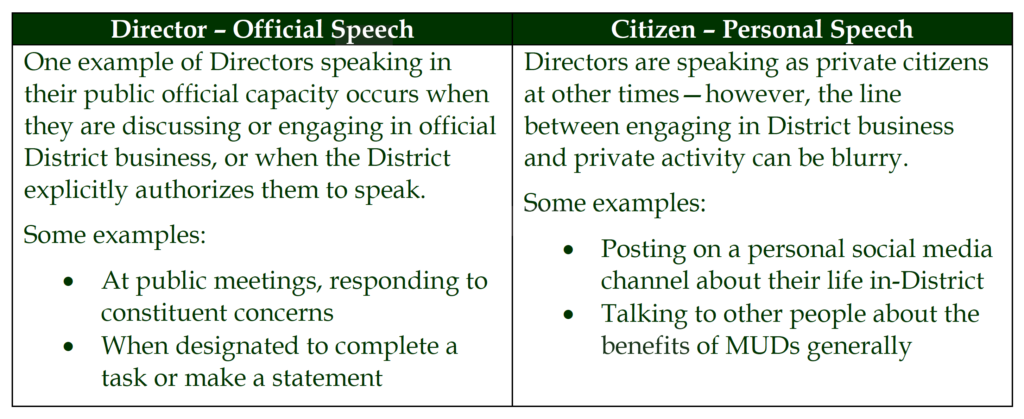
If you are writing or posting on behalf of the district, you should save a record of your post in order to comply with the Texas Public Information Act. Please see the social media and website companion hand- outs for important information.
When speaking in your personal capacity on issues relating to your District, you should include a disclaimer in your communications. Otherwise, recipients may assume that you are speaking in your official capacity as a Director. An example disclaimer is below:
This [post/statement/ article] reflects my own personal views and does not necessarily represent the views or official position of [Insert District].
A walking quorum occurs when a majority of Directors (generally three or more) are engaged in a discussion about District business, even at different times, like in a series of phone calls or text threads. When a quorum of the board discusses district business, it requires notice of a public meeting (even during a “walking quorum”). Walking quorums violate the law and should be carefully avoided.
A District’s Board may appoint one or two Directors to serve as the District’s official “communications” liaison. ABHR recommends this approach. Why?
Directors should consult with their District’s legal counsel to ensure compliance with open meetings requirements, records retention, and other obligations.
District websites provide the public with accessible, trusted platforms to share ongoing information and critical updates about the District, but websites can also highlight the positive impacts that the District is making on residents’ lives. Websites can play a key role in demonstrating District success.
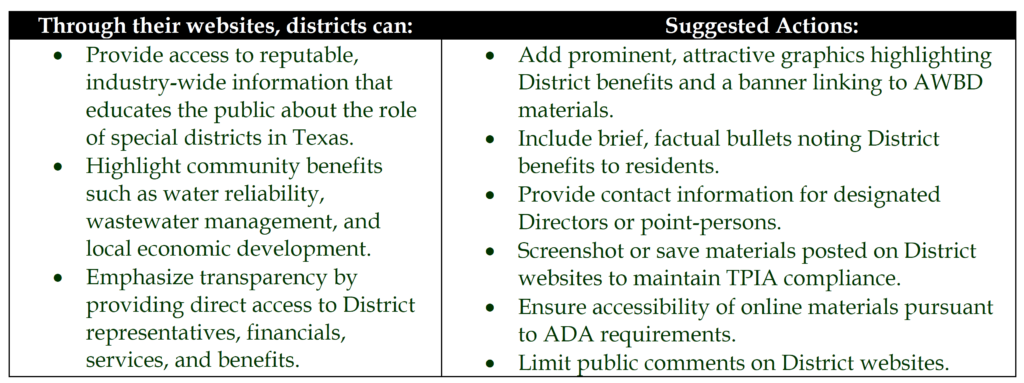
Directors should consider allowing District websites to link to AWBD’s content on the benefits that special districts confer to Texans. As with any other outside links, this content is subject to Districts’ ongoing anti- fraud duties under federal securities laws. Districts may consider including disclaimers on their websites noting that they do not control external sites.
If Districts have designated a Director or employee to engage with the public about District benefits and services, District websites should provide that person’s contact information to facilitate engagement.
To facilitate public trust in District communications, Districts should make sure to distinguish between District- generated content and external resources.
District websites are subject to accessibility rules under the Americans with Disabilities Act- with new rules going into effect in 2028. Districts should work with their website designers to ensure compliance by the deadline, including linking to or hosting AWBD materials.
A walking quorum occurs when a majority of Directors (generally three or more) are engaged in a discussion about District business, even at different times, like in a series of public comments on a District website. When a quorum of the board discusses district business, it requires notice of a public meeting (even during a “walking quorum”). Walking quorums violate the law and should be carefully avoided. Please consult with your District’s legal counsel before allowing public comments on District websites, as such comments may trigger long- term retention obligations for Districts.
Districts should take care to properly screenshot, cache, or otherwise save appropriate District materials posted or linked on District websites, ensuring compliance with document retention obligations under Texas law. Online message boards pose special hurdles to Districts’ document retention duties. Under Texas law, messages must remain posted for longer than 30 days, and even when the post is deleted or removed after those 30 days, it must be retained and archived in accordance with the District’s record retention obligations. Districts may not block or mute message board participants, and Districts must save all message board discussions of District business. Directors should consult with their District’s legal counsel to ensure compliance with records retention and other obligations.
As political subdivisions of the state of Texas, special districts may not use District resources to distribute political advertising in connection with an election. Districts must take care to refrain from engaging in political advocacy – of a candidate, policy, or position – on their websites, and ensure that the district websites do not link to external resources containing the same.
Directors should consult with their District’s legal counsel to ensure compliance with open meetings requirements, records retention, and other obligations.
Social media, including Facebook, LinkedIn, X (formerly Twitter), Instagram, Threads and others, offers an accessible, inexpensive medium for Districts to communicate directly with the public. When used properly, social media can be a powerful tool to keep residents informed, encourage engagement, and educate residents on all the ways special districts impact their lives.
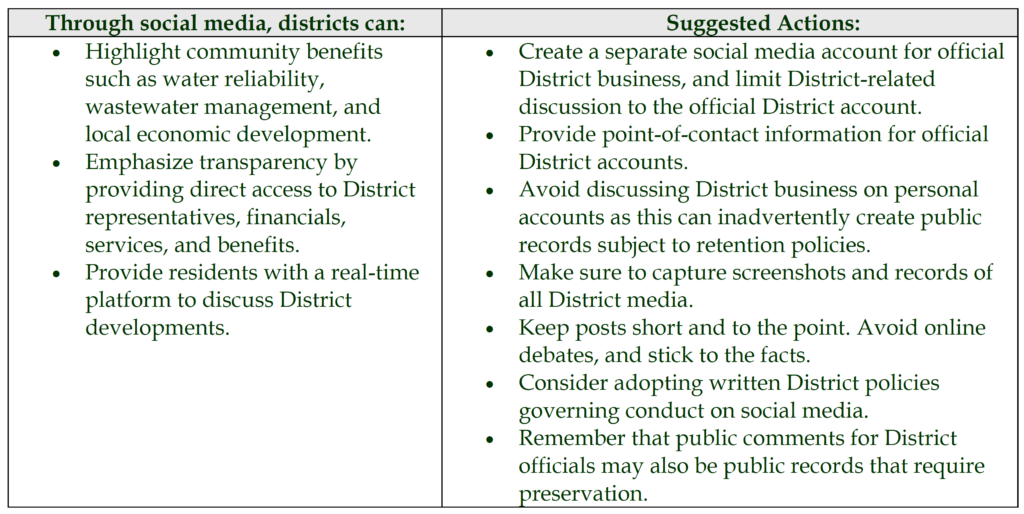
Districts should create separate district accounts for social media and appoint one Director to serve as their official “communications” director. ABHR recommends this approach. Why?
If you are speaking on behalf of the District, you must save government records. To keep things simple, only discuss District business on separate District social media accounts created for the District communications.
A walking quorum occurs when a majority of Directors (generally three or more) are engaged in a discussion about District business, even at different times, like in a series of public comments on a social media post. When a quorum of the board discusses district business, it requires notice of a public meeting (even during a “walking quorum”). Walking quorums violate the law and should be carefully avoided. ABHR recommends that Districts allow a District- appointed communications director to handle all social media discourse to avoid discussing district business outside of officially noticed meetings.
Districts should take care to properly screenshot, cache, or otherwise save appropriate district materials posted to – or replying to – District social media accounts, ensuring compliance with document retention obligations under Texas law. Social media activity on personal social media accounts could also create document retention obligations if directors are discussing District business, so ABHR recommends against discussing District business on personal accounts. Instead, redirect constituents to the official district social media pages.
Districts should take care to uphold rights to free speech. Exercise caution and discuss with legal counsel before blocking, muting, or otherwise deleting comments on official District social media accounts. These issues can also arise if directors are discussing District business on personal social media accounts, which is another reason to redirect all District business to the official District social media accounts.
Directors should consult with their District’s legal counsel to ensure compliance with open meetings requirements, records retention, and other obligations.
On February 7, 2024, the MUD adopted a Resolution Concerning Exemptions from Taxation for the 2024 tax year, which provides for the exemption from ad valorem taxation of $20,000 of the appraised value of residence homesteads of individuals who are disabled or are sixty-five years of age or older.
Exemptions may change from year to year as the tax base of the MUD will be reviewed annually and any exemptions that may be offered will be formally adopted each tax year.
Governor Abbott issued a drought disaster declaration for Fort Bend County. With increased water demand and the Governor’s drought declaration, Sugar Land is activating Stage 1 of its Drought Contingency Plan requesting voluntary water conservation to help reduce peak usage. This declaration applies to all city water systems, including wholesale customers MUD 128- Riverstone, and MUD 192 – Greatwood Lake.
Demand is greatest during weekday mornings and early evenings, primarily due to increases in outdoor irrigation. To reduce peak demand and total water consumption, customers are asked to water lawns twice a week according to the suggested watering schedule below:

All customers are asked to water between the hours of midnight to 10 a.m. or 8 p.m. to midnight.
The City is closely monitoring water production to determine if initiation of Stage 2 – Severe Water Distress Conditions is necessary. Stage 2 includes mandatory watering restrictions of twice per week according to the above schedule. Voluntary reductions lessen the likelihood that the City will need to initiate Stage 2.
The District has implemented a text alert system for the residents of Fort Bend County Municipal Utility District No. 192. This system is designed to keep you informed of issues related to the District in a quick and timely manner. You may receive messages in text alert format related to the water service in the District, drainage and sewer related topics, and other news that is relevant to the District.
Text message notifications will contain a short amount of information with a link back to the District’s website where the remainder of the information can be viewed.
These notifications are a great way to stay up to date on news and issues within the District and we highly encourage you to sign up and share this information with your neighbors.
To sign up for text notifications, please click here to visit the sign-up page.